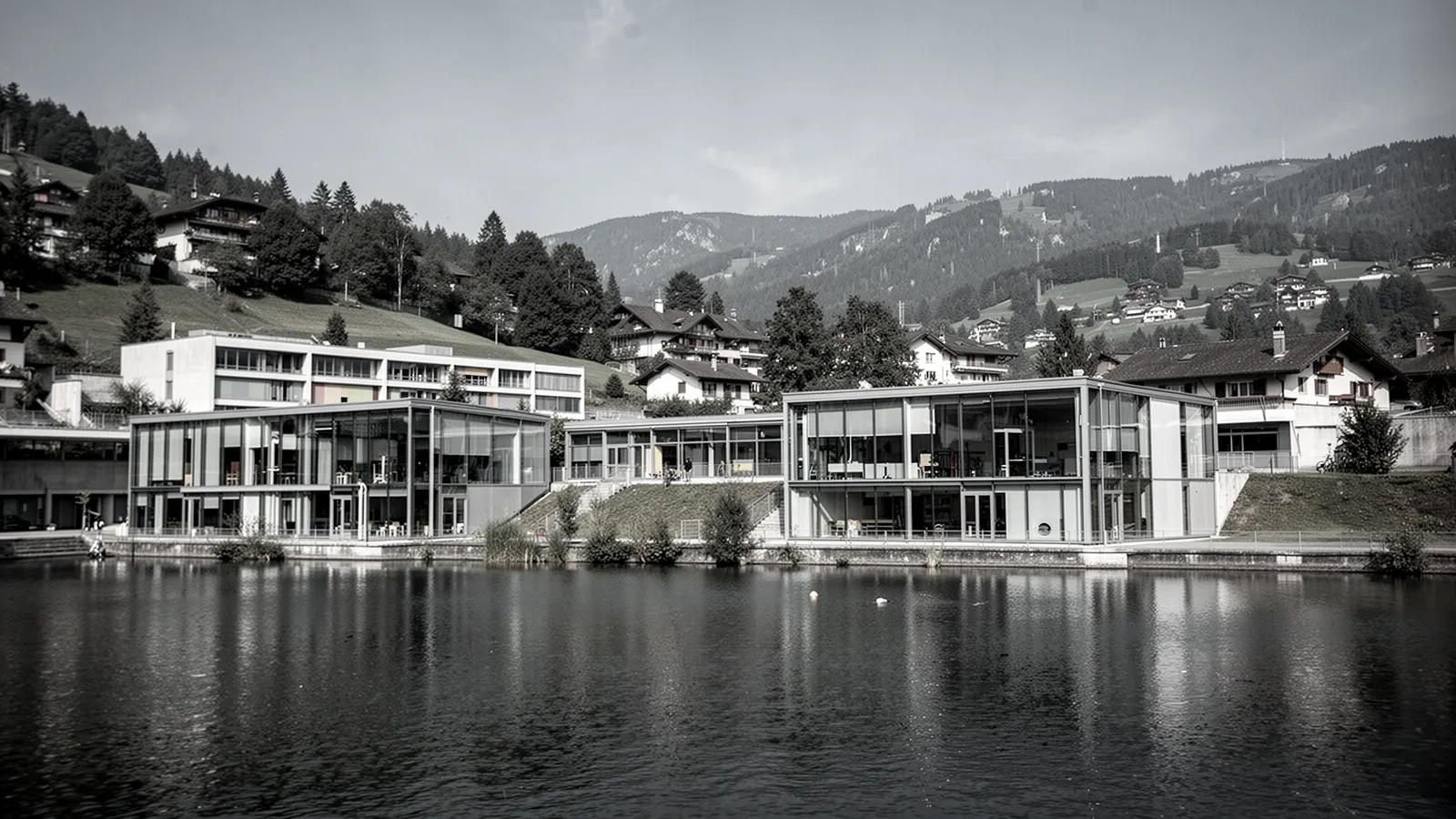
International schools in Switzerland are private institutions. They teach in English or another language of international mobility and follow a foreign or international curriculum. They sit beside the cantonal public system, not inside it. For your transferee's children, the choice affects the start date, the budget and the family's willingness to move.
Switzerland has no single national school system. Each canton runs its own. That is why the school question must be answered by location first, and by school second.
Why the school decision comes first
Most assignment decisions can be reversed in the first months. A school place is harder to change. Moving a child between curricula mid-year is disruptive. Your employee will usually ask about schools before accepting the offer.
For the employer, three points matter:
- Timing. Popular schools fill early in certain regions. Admission is rarely a matter of days.
- Location. The school should be fixed before the housing search, because the commute shapes the choice of municipality.
- Policy. Decide in advance what your policy covers, so that the transferee does not discover the limits after signing.
Fee levels are covered separately in what an international school costs. This page deals with the choice itself.
The main types of school
International schools with the IB
Many international schools offer the International Baccalaureate (IB) programmes. The IB is a continuous framework from primary years to the final diploma. Its main advantage for a mobile family is portability: a child who starts in one IB school can often continue in another country with limited disruption.
Ask each school which IB programmes it is authorised to teach, and whether the whole school is authorised or only part of it. Do not assume that "international" means IB.
Schools following a national curriculum
Some schools teach a British, American, French, German or other national curriculum. These suit families who expect to return to the home system. A UK-bound family may prefer GCSEs and A-levels. A US-bound family may prefer an American high-school diploma with Advanced Placement courses.
Check which qualifications the school actually awards and whether the home country recognises them.
Bilingual schools
Bilingual schools teach in a local language and English, or in two local languages. They are often private, and some are linked to the public system. They suit families who plan a longer stay and want the child to integrate locally. They are less suited to a short assignment, where the child may be moved again.
The public system as an alternative
Public schools are free of tuition but teach in the local language of the canton. For some families this is a sound option, especially for younger children. See public schools in Switzerland and the Swiss school system for how it works.
Choosing: a sequence for your policy
Use a fixed order of questions. It keeps the discussion with the family objective.
The same logic is built into the school choice guide. A specialist can review your policy and the family's constraints; the request at the bottom of the page starts that process.
Waiting lists and application timing
Waiting lists are the main practical risk. They vary by canton, by school, by age group and by time of year. Some schools hold places for the children of international organisations or large employers. Others admit strictly in order of application.
What to ask each school:
- Is there a waiting list for the relevant age group?
- Is a place held if the family's arrival date moves?
- Is an entrance assessment required, and in which language?
- Does the school accept mid-year entry?
- What deposit or registration payment is requested, and is it refundable?
Do not rely on a single school. Apply to several, and keep the family informed of the status of each. A place offered is not the same as a place confirmed: the school will usually ask for documents and a payment before it holds the seat.
Documents to prepare from abroad
Schools generally ask for previous school reports, a record of the child's current curriculum, passports and information on the family's move. Some also ask for a teacher reference or proof of language level. Collect these before departure. Certified translations may be needed for documents not in a Swiss language or English.
Immigration status matters too. Children of nationals from the EU and EFTA and children of third-country nationals follow different admission regimes for the parent's permit, as the State Secretariat for Migration (SEM) explains. A school place does not replace a permit. Review the family's permit route through immigration support before relying on a start date.
What happens after arrival
Your transferee must register with the commune within 14 days of arrival, according to the commune guidance published on the Swiss federal portal. Some communes and cantons vary on this point, so ask which rules apply locally. Registration documents are often needed for a final school enrolment. See enrolling a child after arrival.
Health insurance must also be arranged. The Federal Office of Public Health (FOPH) requires everyone resident in Switzerland to take basic cover within three months of taking up residence. Some schools ask for proof of insurance for children.
Checklist for the HR team
- Confirm the expected length of the assignment
- Ask the family which curriculum it expects to return to
- Agree what the policy covers for school costs
- Shortlist regions before the housing search
- Apply to more than one school
- Gather reports, passports and curriculum records
- Check the permit route for the whole family
- Plan registration with the commune on arrival
A fictional example
Consider a hypothetical family of four moving from Singapore for an open-ended assignment. The older child is close to the final years of secondary school; the younger is in primary. The older child needs curriculum continuity. The younger could adapt to a bilingual school. A single policy rule would not fit both. The specialist reviewing the case would look at each child separately.
Frequently asked questions
Are international schools free in Switzerland?
No. They are private and charge tuition. Public schools are free of tuition but teach in the local language.
Which curriculum is best for an international assignment?
It depends on the length of the stay and the home-country route. The IB is portable. A national curriculum eases a return to that country.
Do all international schools offer the IB?
No. Some follow British, American, French or German curricula. Ask each school what it is authorised to teach.
Can children join in the middle of the school year?
Some schools accept mid-year entry; others do not. Ask when applying, and confirm whether space exists in the relevant age group.
How early should the school search begin?
As early as the transfer is likely. Waiting lists can be long in some regions, so start before the housing search.
Are waiting lists common?
In some cantons and for some age groups, yes. Ask each school directly and do not rely on a single application.
Can an employer reserve places?
Some employers have arrangements with certain schools. Ask the school whether any exist for your organisation.
Is a school place linked to a residence permit?
No. The permit is granted by the authorities. A school place does not replace it. See the permit finder.
Do children need to speak the local language?
Not for English-language international schools. For public or bilingual schools, some language support is usually needed.
What if my employee has no school-age children?
The topic may still arise for a partner. See supporting the accompanying partner.
Which regions have the most international schools?
Should the family visit schools before moving?
Where possible, yes. A visit, or a video meeting with admissions staff, helps the family judge fit.
What documents do schools ask for?
Typically previous reports, passports, the current curriculum record and proof of the move. Requirements differ by school.
Do documents need translation?
Sometimes. Schools may accept English documents. Documents in other languages may need certified translation.
When can my employee register the child?
Registration with the commune follows arrival. The commune guidance cites 14 days, though local rules vary.
Are bilingual schools public or private?
Both exist. Many are private. Check the individual school.
What about secondary school and higher education?
Final-year qualifications matter for university entry. See universities in Switzerland.
What about childcare for very young children?
It is separate from school. See childcare in Switzerland.
Can the school search be outsourced?
Yes. A school search service can be part of a wider relocation package.
How do I start a request?
Use the request at the bottom of this page. A specialist will look at the family's situation.
Sources
Related pages
- Schools in Switzerland for expatriate families
- The Swiss school system
- Public schools in Switzerland
- What an international school costs
- Enrolling a child in school after arrival
- Childcare and after-school care in Switzerland
- Universities and higher education institutions f
- Supporting the accompanying partner