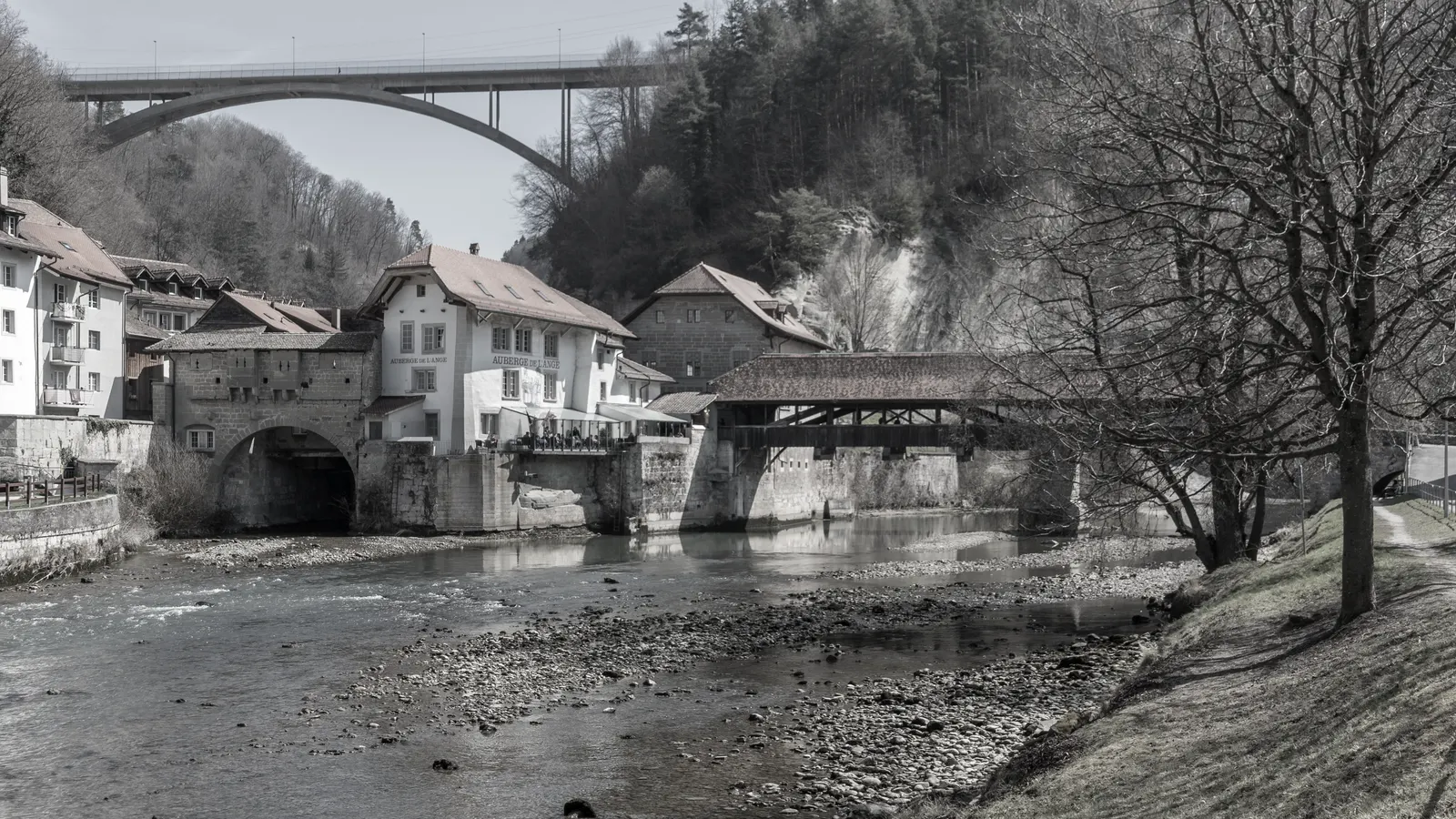
Living in Fribourg suits an employee who wants a compact city with a university atmosphere and two working languages. It is not a large business hub. Your transferee should know this before accepting the posting.
This page briefs your mobility team on what the city is like, what to decide early, and where the Swiss terms matter. It is written for employees arriving from abroad, not for people already living in Switzerland.
A bilingual city: what it means for your employee
The canton of Fribourg (FR) is officially bilingual, in French and German. The Swiss Confederation lists it with Bern and Valais as an officially bilingual canton (Presence Switzerland). The city itself is mostly French-speaking, but this is not backed by an official statistic, so treat it as a general description.
In practice, your employee will meet both languages. Public notices, school choices and neighbours' conversations can switch between the two. The employer should clarify early:
- which language the employee will use at work;
- which language the household will need for daily admin, such as the commune (Gemeinde) and the school;
- whether language courses are part of the policy, for the employee and for the accompanying partner.
A transferee who speaks only English can function in the first weeks. Anything official, however, is easier with some French or German. Build this into the assignment letter rather than leaving it to chance.
Who lives in Fribourg
At the end of 2025, the permanent resident population of Fribourg was 39,599 people (FSO, STATPOP). Of these, 15,952 were foreign nationals, or 40.3% (FSO, STATPOP). Your employee will therefore not be the only newcomer. Many neighbours, colleagues and school parents will also come from abroad.
A city of this size is easy to understand. Distances are short and the old town is compact. Daily life tends to be quieter than in Zürich or Geneva. For a family, this is often an advantage. For a single transferee who expects a big international scene, it may feel small. Compare the options with the pages on Zürich, Geneva and Bern before you fix the destination.
The table is a general orientation, not a ranking. A specialist can test it against your employee's actual role through the request at the bottom of the page.
Housing: read the canton, not the city
Rent data for the city alone is not available from the Federal Statistical Office. The figures below are for the whole canton of Fribourg, so use them as an order of magnitude only.
In 2024, the average net rent in the canton was CHF 1,328 per month for all sizes (FSO, table T 09.03.03.01). By size of home, the same source gives:
| Home size | Average net rent, canton of Fribourg, 2024 |
|---|---|
| 1 room | CHF 758 per month |
| 2 rooms | CHF 1,074 per month |
| 3 rooms | CHF 1,299 per month |
| 4 rooms | CHF 1,539 per month |
| 5 rooms | CHF 1,867 per month |
| 6 rooms or more | CHF 2,262 per month |
These are averages of existing leases (FSO). A new lease signed by a newcomer is often priced differently, and the city centre may differ from the canton. Do not use these numbers as a budget cap in the policy. Use them to explain the general level to your employee.
Availability is the second question. On 1 June 2026, the vacancy rate in the canton was 1.26% (FSO, table T 09.03.04.03). We have no verified figure for the city itself, so do not infer it from the canton. What you can say is that the search needs time and a complete file. Landlords and agencies (régies) usually ask for identity documents, proof of income and a residence permit or contract.
For a transferee abroad, this creates a sequence problem. The employee cannot visit every flat from another country. Plan for:
- a short look-and-see trip, or a temporary furnished stay;
- a rental file prepared before departure;
- clear rules on who signs the lease, the employee or the company.
Our home search service page explains how a partner company can handle the search. The rental file checker helps test the documents beforehand.
Schools and children
Schooling is organised by the canton, and the language of instruction follows the school's language region. In a bilingual canton, this choice matters. A child who arrives at secondary age with no French or German faces a harder start than a young child.
For international schools, we hold no verified list for Fribourg. Ask the canton or the relevant association of international schools before you promise a place. Do not tell the family that an English-language option exists until it is confirmed.
Three questions help the family decide:
- What language does the child speak at home and at the current school?
- How long will the assignment last?
- Is the family likely to stay in Switzerland afterwards?
The school choice guide lays out the logic. Admission rules and any waiting lists are set locally, so a specialist should check them against the child's age.
Getting there and getting around
We have not verified airport links or public transport times for Fribourg, so this page gives no durations. The city lies on the Swiss rail network. Your employee should check the national timetable for the actual route from the nearest international airport and decide whether a car is needed. In compact cities, many households manage without one, but this depends on the workplace and the commune chosen.
If the employee will import a vehicle, that is a separate customs question and not a city-level one.
The cantonal migration office
Permits for the canton are handled by the Service de la population et des migrants (SPoMi), the cantonal migration office. Its page is on the canton's official website. The State Secretariat for Migration (SEM) lists all cantonal authorities.
Your employee does not apply alone in most cases. The employer usually starts the work-permit procedure before departure. Whether the permit is granted is a decision for the authorities, not for the employer or for us. Procedures differ for EU/EFTA nationals and third-country nationals. Our immigration support page describes the support that is available, and the permit finder gives a first orientation.
The first days on site
A practical order helps the transferee settle without losing weeks:
- Confirm the permit status and the entry conditions before travelling
- Register with the commune of residence after arrival
- Take out the mandatory health insurance within the period set by the authorities
- Open a bank account for rent and salary
- Enrol the children at school
- Book a language course
Registration deadlines vary, and the commune will tell your employee what applies. The settling-in service page describes how a partner company can accompany these steps, and the relocation calendar shows the sequence. If you want a specialist to review the assignment, use the request at the bottom of the page, or read about relocation support.
Frequently asked questions
Is Fribourg a good place to live for an English-speaking transferee?
It can be, if the employee is willing to learn French or German. English helps in daily life and at work in many settings, but official procedures and schools run in the local languages. Plan language support from the start.
What language is spoken in Fribourg?
The canton is officially bilingual, in French and German (Presence Switzerland). The city is mostly French-speaking in general terms, although no official statistic confirms this. Your employee will hear both.
How many people live in the city?
The permanent resident population was 39,599 people in 2025 (FSO, STATPOP). It is a small city by international standards.
Are there many foreign residents?
Yes. In 2025, 15,952 residents were foreign nationals, or 40.3% of the population (FSO, STATPOP). A newcomer is therefore not unusual.
How much is the rent?
The Federal Statistical Office gives an average net rent of CHF 1,328 per month for the canton in 2024, all sizes combined (FSO, table T 09.03.03.01). There is no value for the city alone. Use it as an order of magnitude and ask a specialist about current offers.
Is it hard to find a flat?
The canton's vacancy rate on 1 June 2026 was 1.26% (FSO, table T 09.03.04.03). We have no verified rate for the city. Expect a competitive search and prepare a full rental file before departure.
Which office handles residence permits?
The Service de la population et des migrants (SPoMi) is the cantonal migration office. The final decision on a permit rests with the authorities.
Are there international schools in Fribourg?
We cannot confirm this. No verified list was available when this page was prepared. Check with the canton before telling the family anything, and see the school choice guide.
Can the employee live without a car?
This depends on the workplace and the commune. We have not verified transport details, so check the rail and local timetables for the actual commute.
Does the employer or the employee sign the lease?
Both models exist. The choice depends on your policy, on tax and liability, and on the landlord. Ask a specialist to review your case through the request at the bottom of the page.
Should we compare Fribourg with other cities first?
Yes, if the role allows it. Compare language, pace and housing with Lausanne and Neuchâtel, then use the city comparator.
Sources
- Swiss Confederation (Presence Switzerland), Multilingualism
- Federal Statistical Office (FSO), permanent resident population (STATPOP)
- Federal Statistical Office (FSO), average net rents, table T 09.03.03.01
- Federal Statistical Office (FSO), vacant dwellings by canton, table T 09.03.04.03
- State Secretariat for Migration (SEM), cantonal migration authorities