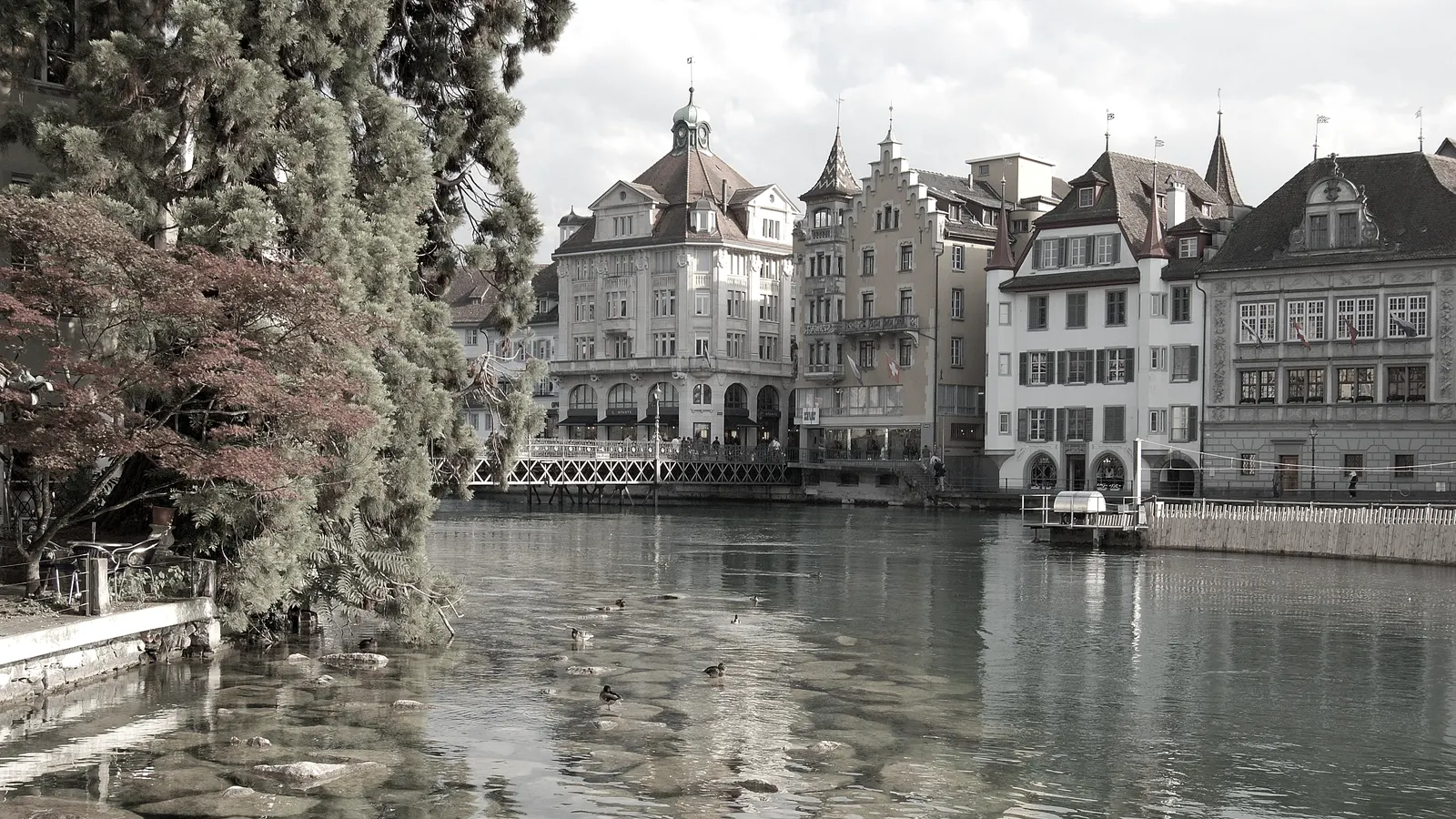
Living in Luzern means a small, orderly city on a lake, with the Alps close by. For an employer, it is a destination where the assignment itself is often straightforward, but where housing search and schooling need early planning. This page covers what a transferee arriving from abroad will meet, and what your policy should anticipate.
Where Lucerne sits and what daily life looks like
Lucerne (Luzern in German) is the main city of the canton of Lucerne, in central Switzerland. It lies on a lake, at the point where the river Reuss leaves it. The old town, the wooden Chapel Bridge and the mountain backdrop define the setting.
Daily life is compact. Most services sit within a short distance of the station and the lakefront. Many transferees find the pace calmer than in Zurich, and the choice of employers, restaurants and cultural venues narrower.
German is the language of daily life, in its Swiss German form. Written administration is in standard German. A transferee who arrives without any German can manage in many professional settings, but forms, school contacts and landlord correspondence are in German. Budget for language support in your policy.
Size and population
In 2025, the permanent resident population of the city was 86,699 people (FSO). Of these, 24,439 held a foreign nationality, which is 28.2% of residents (FSO). An international newcomer therefore joins an established foreign community, though the city is far smaller than Zurich or Geneva.
Housing: what to expect
Rental housing in Switzerland is handled through a landlord or a property manager (régie in French, Verwaltung in German). The tenant usually submits a file with identity, income and residence documents. A transferee who has not yet arrived often lacks the local documents that a landlord expects, such as a debt enforcement extract (Betreibungsauszug). The rental file checker lists what a typical file contains.
The FSO reports the following average net rents for the city, from the 2022-2024 cumulated survey. Figures for six rooms and more are imprecise.
- All dwelling sizes: CHF 1,492 per month (FSO).
- One room: CHF 886 per month (FSO).
- Two rooms: CHF 1,256 per month (FSO).
- Three rooms: CHF 1,458 per month (FSO).
- Four rooms: CHF 1,685 per month (FSO).
- Five rooms: CHF 2,145 per month (FSO).
For the canton as a whole, the FSO gives an average net rent of CHF 1,500 per month in 2024. For a three-room dwelling, the cantonal figure is CHF 1,448 per month (FSO).
These are averages of existing tenancies. They are not the asking rents of dwellings advertised today, which tend to differ. Treat them as an order of magnitude for a housing allowance, not as a market quote.
Availability
On 1 June 2026, the vacancy rate for the canton of Lucerne was 0.7% (FSO). This is a cantonal figure. It does not show the rate for the city itself, which has not been established here. A low rate generally means a tight market and a longer search, so a transferee who arrives with no home may need temporary accommodation first. The home search service and the page on relocation services in Switzerland explain how a referral works.
Schools and families
Public schooling in Switzerland is organised by canton and commune. The language of instruction in Lucerne is German. For a child who does not speak German, this is the main school question to settle before the move.
Private and international options exist in some Swiss cities. For Lucerne, no verified list is available here, so none is named. The canton's education authority can say what is offered, and the school choice guide sets out the questions to ask. Compare with Zurich, Zug and Geneva, where the international school offer is a larger part of the assignment decision.
Transport and getting there
Lucerne is a rail hub, and the city centre is walkable. Details of connections, travel times and season tickets have not been verified for this page, so they are not stated. Ask the national rail operator and the local transport provider for current information. Check the commute to the employee's workplace before signing a lease, since the workplace may be outside the city.
Permits and the cantonal migration office
Entry and residence rules depend on nationality and employment. EU and EFTA nationals and third-country nationals follow different procedures, and the authorities decide each case. The permit finder gives a first orientation, and the immigration support service covers the employer side.
For Lucerne, the competent authority is the cantonal migration office, the Dienststelle Migration (Kanton Luzern). It is listed on the website of the State Secretariat for Migration (SEM). Its own portal is at migration.lu.ch.
The trade-offs for your policy
Lucerne trades the scale and career options of a larger centre for a quieter setting. For a transferee with a partner who also works, check local job opportunities early. For a family, confirm the school plan before the housing decision. The city comparator helps to set Lucerne beside other destinations.
First days after arrival
- Register with the commune of residence (Einwohnerkontrolle) within the period the commune sets.
- Confirm basic health insurance, which is compulsory within three months of arrival.
- Open a bank account and arrange the rental deposit.
- Enrol children in school with the local authority.
- Collect the residence permit card when the migration office issues it.
The relocation calendar and the settling-in service set these steps in order. To have a specialist examine a particular case, use the request at the bottom of the page.
Frequently asked questions
Is Lucerne a good place for a transferee to live?
It suits those who want a compact city near the lake and mountains. It offers less scale than Zurich. Fit depends on the employee's job, family and language skills.
What language is spoken in Lucerne?
German, in its Swiss German form, is the language of daily life. Written administration uses standard German. Language support for the employee and family is worth including in the policy.
How many people live in the city?
In 2025, the permanent resident population was 86,699 people (FSO). This makes it a small city by international standards.
How many foreign residents are there?
In 2025, 24,439 residents held a foreign nationality, which is 28.2% of the population (FSO).
What is the average rent in Lucerne?
The FSO reports an average net rent of CHF 1,492 per month across all sizes for 2022-2024 (FSO). This is an average of existing tenancies, not of current listings.
How tight is the housing market?
On 1 June 2026, the vacancy rate for the canton was 0.7% (FSO). The rate for the city alone has not been established. A low cantonal rate points to a competitive market.
Can a transferee rent before arriving?
Sometimes, but landlords usually want documents that a newcomer lacks. Temporary accommodation is a common first step. The rental file checker lists the usual documents.
Which authority handles residence permits?
The Dienststelle Migration of the canton of Lucerne. It is listed by the State Secretariat for Migration (SEM). The authority, not an agency, decides on each permit.
Are there international schools in Lucerne?
No verified list is available for this page. The cantonal education authority can confirm what exists. The language of public schooling is German.
What does the transferee need to do on arrival?
Registration with the commune and basic health insurance come first. Basic health insurance is compulsory within three months of arrival. The checklist above sets out the usual sequence.
How does the referral work?
The site connects the employer with a relocation company that fits the request. The request at the bottom of the page starts the process. A specialist then examines the case.
Sources
- Federal Statistical Office (FSO), permanent resident population
- Federal Statistical Office (FSO), structural survey, rents in the largest cities
- Federal Statistical Office (FSO), average net rent by canton
- Federal Statistical Office (FSO), vacant dwellings by canton
- State Secretariat for Migration (SEM), cantonal migration authorities