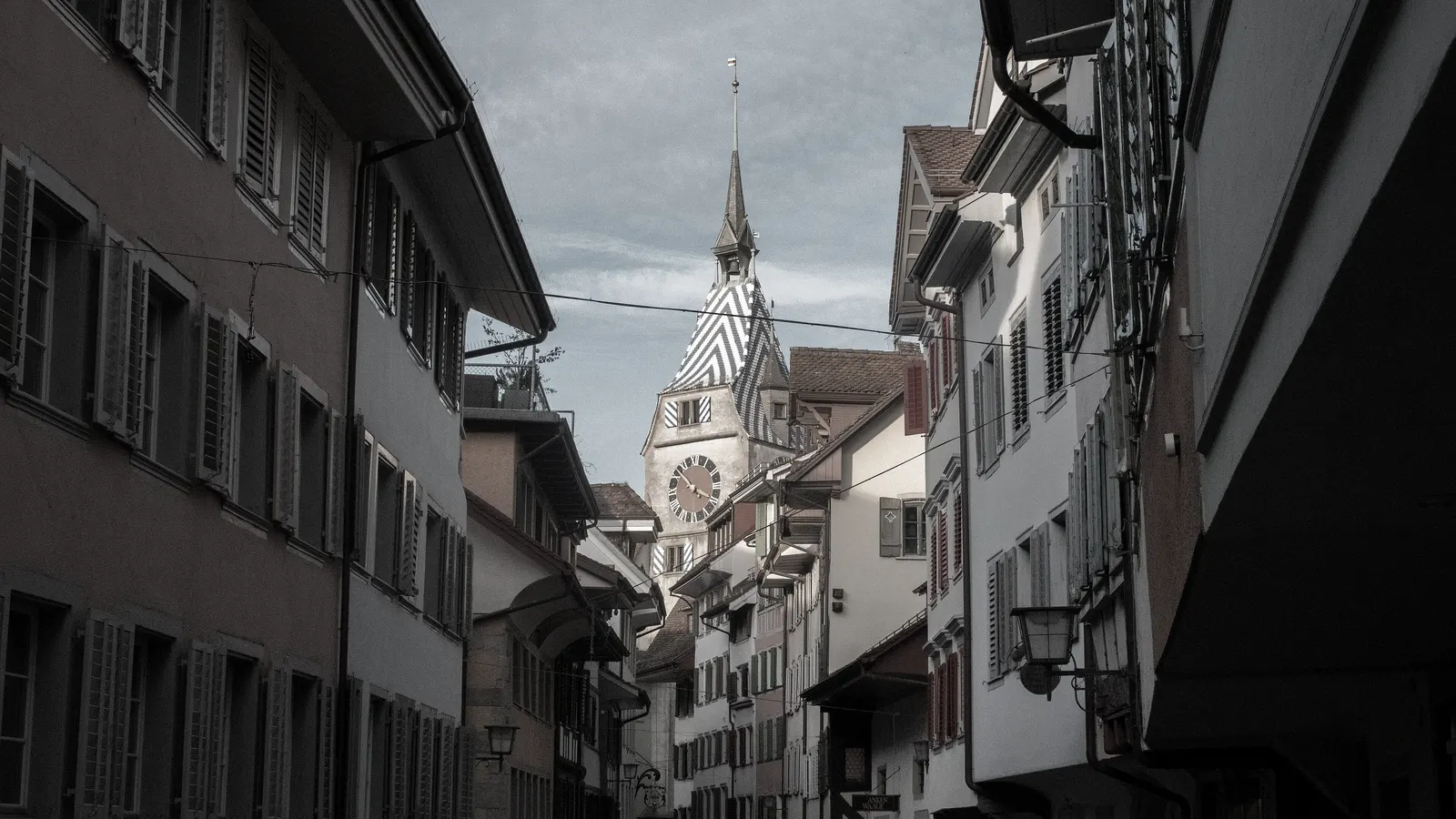
Life in Zug is a question of scale. The town sits on the shore of Lake Zug in central Switzerland. It is small, and it works as a business location with an international workforce. Your transferee will find a short commute, a lake and mountain setting, and a housing market with very little slack.
This page gives your mobility team a first picture of the destination. It covers who lives there, how the rental market behaves, what to check on schools and tax, and where the permit process starts.
Zug at a glance
The permanent resident population of Zug was 32,160 people in 2025 (Federal Statistical Office, FSO). Of these, 12,007 were foreign nationals, or 37.3% (FSO). That share explains much of the town's character. Your transferee will not be the only newcomer, and daily services are used to people arriving from abroad.
Zug is also the name of a canton. Many rules that matter to an employer are set at cantonal level: the migration office, the tax regime, the school system and the rental statistics used below. When a Swiss source speaks of "Zug", check whether it means the town or the canton.
For a transferee who has never lived in Switzerland, expect a quiet, orderly place. Evenings are calm. Services are close together. Larger cultural and shopping offers are a short journey away, and your transferee may look at Zürich or Lucerne for comparison.
The housing market: where the pressure is
Housing is the first issue to put on your timeline. The vacancy rate in the canton of Zug was 0.2% on 1 June 2026 (FSO). A rate this low means few homes are on the market at any time, and landlords can choose among many applicants. No vacancy rate is available for the town alone, so do not read the cantonal figure as a town figure.
Average net rents give an order of magnitude. The FSO figures below are for the canton, not the town, and refer to 2024.
| Dwelling size | Average net rent, canton of Zug, 2024 (FSO) |
|---|---|
| 1 room | CHF 1,029 |
| 2 rooms | CHF 1,579 |
| 3 rooms | CHF 1,875 |
| 4 rooms | CHF 2,270 |
| 5 rooms | CHF 2,770 |
| 6 rooms or more | CHF 3,428 |
Across all sizes, the cantonal average net rent was CHF 2,024 per month in 2024 (FSO). These are averages of existing leases. A new lease signed today for a home in the town can differ, so treat the numbers as a starting point for budgeting, not as a quote.
What this means for your policy
- Start the search early. A short notice period between offer and arrival leaves little chance of a good match.
- Fund temporary housing. Your policy should say how long a transferee may stay in temporary accommodation and who pays.
- Widen the search area. Neighbouring communes and the wider region may offer more choice. Ask your relocation provider which areas fit the commute.
- Prepare the rental file abroad. Landlords expect a complete application. The rental file checker lists what to gather before departure.
- Check the lump sum. If you pay a fixed housing allowance, compare it with the cantonal figures above (FSO) and with the family size.
The home search service is one way to obtain local support. The request form at the bottom of the page lets you describe the assignment.
Tax context
Switzerland taxes at three levels: the federation, the canton and the commune. Rates differ between cantons and communes. Zug is often discussed by international employers for this reason. Do not rely on general reputation, though.
What your transferee will actually pay depends on salary structure, family status, permit type, the date of arrival and, for some nationalities, tax treaty rules. For employees from the United States, the United Kingdom, India or Australia, home-country tax duties may continue after the move. This page gives no tax advice and no rate. A tax specialist should review each case, and the request form is the way to ask for an introduction.
For HR, the practical points are these:
- Decide whether your policy covers tax equalisation or a tax briefing.
- Ask your payroll team when Swiss payroll registration and social-security affiliation must be in place.
- Check how your allowances are treated, in particular housing and school fees.
Schools
Families usually ask about schools before they ask about anything else. The town and canton offer public schools, and the wider region has international schools. No official list of international schools in the canton has been confirmed for this page, so we name none. Check each school directly for current availability and fees.
Questions to put to a school before your employee commits to an address:
- What is the language of instruction, and is there support for children who do not speak it?
- Are places available for the start date, or is there a waiting list?
- Which curriculum does the school follow, and does it match the one the child leaves?
- What are the fees, and does your policy cover them in full or in part?
- Does the school admit children from outside its catchment area?
Public schools are usually tied to the commune of residence. That is why the choice of home and the choice of school should be settled together. The school choice guide sets out the decision step by step.
Language, transport and daily life
The canton's official language has not been confirmed for this page. Ask the migration office and the commune which language they use for forms and appointments, and plan any language support for the accompanying partner accordingly.
Details on rail links, airport access and local transport have not been verified for this page, so we give no journey times. Your relocation provider can confirm the commute between candidate homes and the workplace before your employee signs a lease.
Permits and the cantonal migration office
The permit procedure depends on nationality, the type of employment and the family situation. Citizens of the EU and EFTA follow a different route from citizens of other countries. The permit finder gives a first orientation, and the immigration support service covers filing. The authorities decide on each application. No outcome can be assumed.
The competent body is the Amt für Migration of the Canton of Zug, which means the cantonal migration office. It is listed among the cantonal authorities by the State Secretariat for Migration (SEM). Its page is on the canton's website, linked in the sources below.
Comparing Zug with other destinations
| Criterion | Zug | Larger city |
|---|---|---|
| Size | Compact town | Larger urban area |
| Housing | Very tight | Tight, wider choice |
| Choice of schools | To be checked directly | Broader international offer |
| Tax | Cantonal and communal | Cantonal and communal |
To compare several locations side by side, use the city comparator. For other cities, see Geneva and Bern.
First days on the ground
Plan the arrival in a fixed order. The relocation calendar gives a sequence you can adapt.
- Confirm the home and the lease before the flight
- Prepare passports, permit documents and civil-status certificates
- Arrange registration with the commune of residence
- Arrange basic health insurance for the whole family
- Confirm the school place and start date
- Open a bank account
The settling-in service can support these steps on site. To start, use the relocation support request.
Frequently asked questions
Is Zug a good place to relocate employees?
It suits transferees who want a small, international setting. The main constraint is housing. Check supply and budget before you confirm a start date.
How many people live in Zug?
The permanent resident population was 32,160 in 2025 (FSO). Foreign nationals made up 12,007 of them, or 37.3% (FSO).
How tight is the housing market?
The canton's vacancy rate was 0.2% on 1 June 2026 (FSO). The town's own rate has not been confirmed, so do not assume it equals the cantonal one.
What are typical rents in Zug?
The average net rent in the canton of Zug was CHF 2,024 per month across all sizes in 2024 (FSO). A 3-room home averaged CHF 1,875 (FSO). Current offers can differ.
Are the rent figures for the town or the canton?
They are for the canton. The FSO figure used here does not cover the town alone.
How early should the home search begin?
As early as the assignment is agreed. With so little supply, a late start often means a longer stay in temporary housing.
Does Zug have international schools?
The region has international schools, but no official list was confirmed for this page. Ask each school about places, fees and curriculum.
Who issues the work and residence permit?
The cantonal migration office handles the file, and the authorities decide. The office is the Amt für Migration of the Canton of Zug.
Will my employee pay less tax in Zug?
That depends on the individual case. Tax is set at federal, cantonal and communal level, and a specialist should review each situation. The request form can start an introduction.
Which language is used in Zug?
The official language has not been confirmed for this page. Ask the migration office and the commune which language they use for forms and appointments.
Can the relocation provider guarantee a home or a permit?
No. Homes depend on landlords and permits depend on the authorities. A provider can prepare the file and the search.