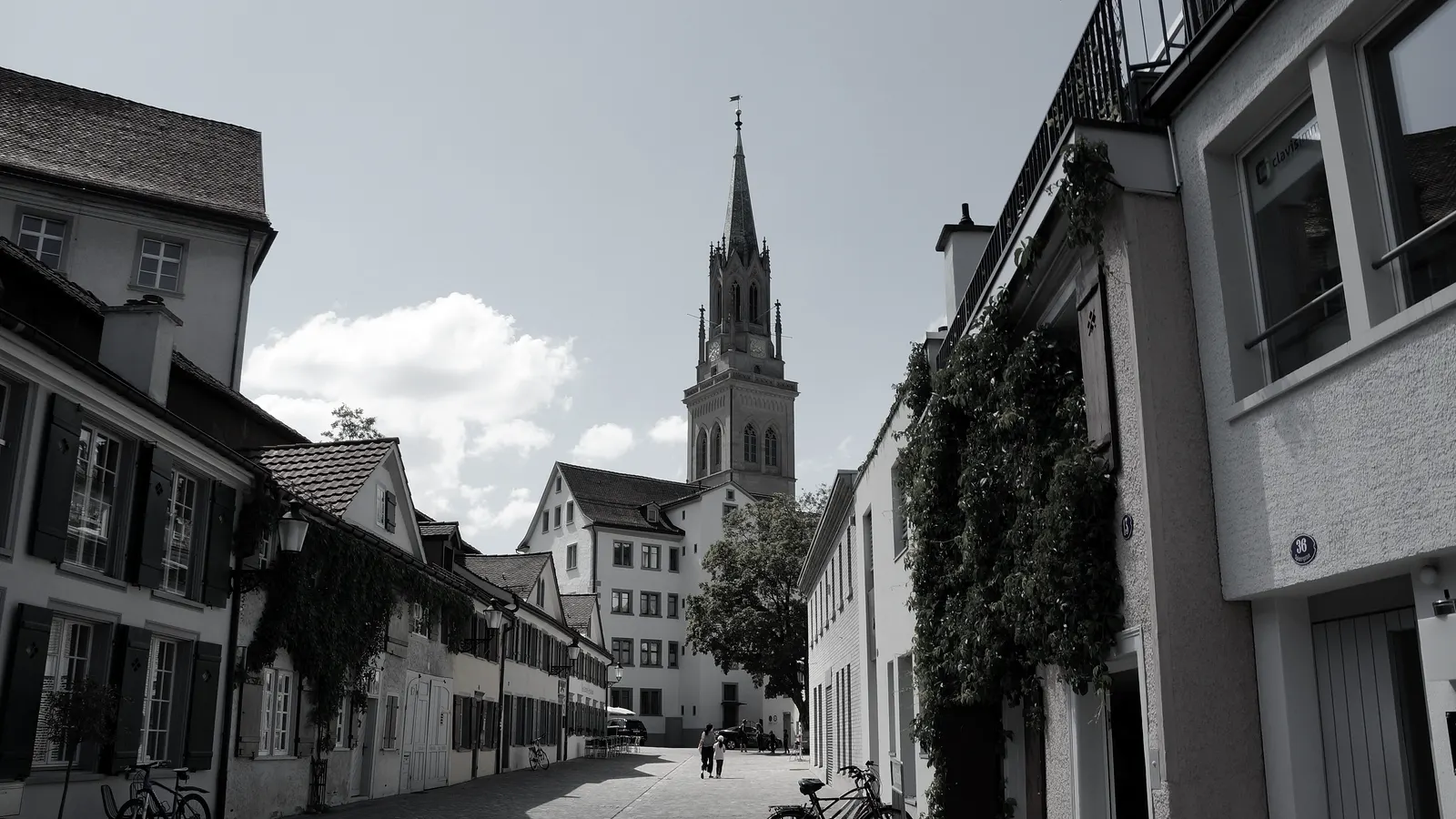
St Gallen is a city in eastern Switzerland, the seat of the canton of St. Gallen (SG). It is known for its historic abbey quarter, its university and its textile heritage. For an employer, it offers a smaller and calmer base than Zürich, with a clear regional identity.
This page helps you decide whether living in St Gallen fits your transferee, and what to prepare before the move. Your employee will not have lived here before. Plan the move with that in mind.
A snapshot of the city
The city of St. Gallen had a permanent resident population of 79,487 in 2025 (Federal Statistical Office, FSO). Of these, 27,471 were foreign nationals, or 34.6% (FSO, 2025). Your transferee will therefore arrive in a city where international residents are a normal part of daily life.
Expect German to be the language of daily life and administration. Confirm the working language of each office with the authority concerned. Many transferees manage in English at work, but forms, tenancy documents and school contacts are likely to be in German. Budget time for language support in your policy. A short course before departure helps.
Why employers choose eastern Switzerland
Employers typically cite three reasons:
- a university-city atmosphere, which brings a steady flow of events and a younger population;
- a compact centre, where the old town and the main services sit close together;
- a lower-key housing market than the largest Swiss cities, which can simplify home search.
Treat these as general features, not guarantees. A specialist can match them to your transferee's profile through the request at the foot of the page.
Housing: what the figures show
Rents are the main budget item to explain to a transferee. The Federal Statistical Office (FSO) reports an average net rent of CHF 1,264 per month for all dwelling sizes in the city (structural survey, 2022-2024 cumulated). A three-room flat averages CHF 1,240 (FSO, 2022-2024), and a two-room flat CHF 1,037 (FSO, 2022-2024).
These are averages for existing tenancies. A new lease signed from abroad is often priced differently. Present them to your employee as an order of magnitude, not a quote.
At canton level, the average net rent was CHF 1,343 in 2024 (FSO). The vacancy rate across the canton stood at 1.16% on 1 June 2026 (FSO). Do not read that as a figure for the city itself. No municipal vacancy rate is confirmed here.
The two columns cover different periods. Compare them with care. Source: Federal Statistical Office (FSO).
79,487 people
Permanent resident population, 2025
Source: Federal Statistical Office (FSO)
34.6%
Foreign nationals, share of residents, 2025
Source: Federal Statistical Office (FSO)
CHF 1,264 per month
Average net rent, all sizes, city
Source: Federal Statistical Office (FSO), 2022-2024
1.16%
Vacant dwellings, canton, 1 June 2026
Source: Federal Statistical Office (FSO)
How the home search works
Most flats are let through a managing agent (régie, or Verwaltung in German) or directly by the owner. The landlord asks for a rental application file and usually a deposit. Your employee will need documents from the home country, so start early.
For a step-by-step view of the process, see the home search service page. To test a file before applying, use the rental file checker.
Neighbourhoods and surroundings
The old town is the historic core, with pedestrian streets and many shops. Residential districts spread across the slopes around the centre. Neighbouring municipalities offer more space and often a quieter setting, at the cost of a longer commute.
Your transferee should visit before signing anything, ideally during a look-and-see trip. Ask the housing specialist which districts match the family's priorities. Use the city comparator for a wider view.
Schools and families
Schooling is organised by the canton and the municipality. State schools teach in German. For a family with school-age children, language is the first question to settle.
No verified list of international schools is available for this page, so none is named. Ask the canton or a specialist to confirm what exists before you promise a school place in the relocation offer. Our school choice guide sets out the questions to ask. For comparison, see how Zürich handles the same topic.
Permits and the cantonal migration office
The permit your transferee needs depends on nationality, the type of employment and the contract. The authorities decide each case. Nothing in this guide is a promise of approval.
In this canton, residence matters are handled by the Migrationsamt des Kantons St.Gallen, the cantonal migration office. Its page is listed by the State Secretariat for Migration (SEM). Start with the permit finder to see which route is likely to apply. The immigration support page explains how a specialist can help.
First weeks on site
Plan the sequence before departure:
- Confirm the permit route and the documents needed from the home country.
- Agree who pays for temporary accommodation and for how long.
- Prepare the rental application file.
- Arrange health insurance and a bank account for the first weeks.
- Plan German lessons for the transferee and any spouse or partner.
- Book the local registration appointment as soon as the address is known.
The relocation calendar turns this into a timeline. A settling-in service can support the first days on site. For a broader view of providers, read about relocation services in Switzerland.
If you want a specialist to review your case, use the relocation request form.
Frequently asked questions
Is St Gallen a good place for an international transferee?
It can be, if your employee values a compact city and a calmer pace. Language is the main adjustment. A specialist can assess fit for your case.
What language is spoken in St Gallen?
German is expected to be the everyday language. Confirm requirements with each authority or school. Plan language support for the whole household.
How big is the city?
St. Gallen had 79,487 permanent residents in 2025 (FSO). It is a mid-sized Swiss city, much smaller than Zürich.
How international is the population?
Foreign nationals made up 34.6% of residents in 2025 (FSO). Your transferee will not be unusual as a newcomer.
What does an average rent cost?
The average net rent for all sizes was CHF 1,264 per month in the city (FSO, 2022-2024). Treat it as an order of magnitude only.
Is it easier to find a flat than in Zürich?
We cannot compare the two on verified figures here. The canton-wide vacancy rate was 1.16% on 1 June 2026 (FSO). A specialist can describe current conditions.
Can we arrange housing before arrival?
Often yes, but it depends on the landlord and the documents available. Start the file early and allow for temporary accommodation.
Which authority handles permits?
The Migrationsamt des Kantons St.Gallen, the cantonal migration office. Its details are listed by the State Secretariat for Migration (SEM).
Are there international schools?
No verified list is available for this page. Ask the canton or a specialist before you make any commitment to a family.
How do we get started?
Send the relocation request at the foot of the page. A specialist then examines your case and your policy.
Does the transferee need a car?
We cannot confirm transport links or timings from verified sources here. Check local public transport options with a specialist before deciding.
Sources
- Federal Statistical Office (FSO), permanent resident population
- Federal Statistical Office (FSO), average rents in the largest cities
- Federal Statistical Office (FSO), average rents by canton
- Federal Statistical Office (FSO), vacant dwellings by canton
- State Secretariat for Migration (SEM), cantonal migration authorities